Lifetimes
Lifetimes บอก compiler ว่า references มีอายุนานเท่าไหร่ ป้องกัน dangling references
⚠️ คำเตือน: Lifetime เป็นหัวข้อที่ยากที่สุดใน Rust
- ❌ อย่าใช้
'staticเพื่อแก้ทุก error- ❌ อย่าเดา lifetime แบบสุ่ม
- ✅ เข้าใจปัญหาก่อนแก้
- ✅ ใช้ owned types (String แทน &str) เมื่อสงสัย
📋 Lifetime Cheatsheet
| สถานการณ์ | ต้องใส่ Lifetime? | ตัวอย่าง |
|---|---|---|
| Return reference จาก function | ✅ ใช่ | fn foo<'a>(x: &'a str) -> &'a str |
| 1 input reference | ❌ ไม่ต้อง (elision) | fn foo(x: &str) -> &str |
Method with &self | ❌ ไม่ต้อง (elision) | fn bar(&self) -> &str |
| Struct เก็บ reference | ✅ ใช่ | struct Foo<'a> { x: &'a str } |
| Static string | ❌ ไม่ต้อง | let s: &'static str = "hello" |
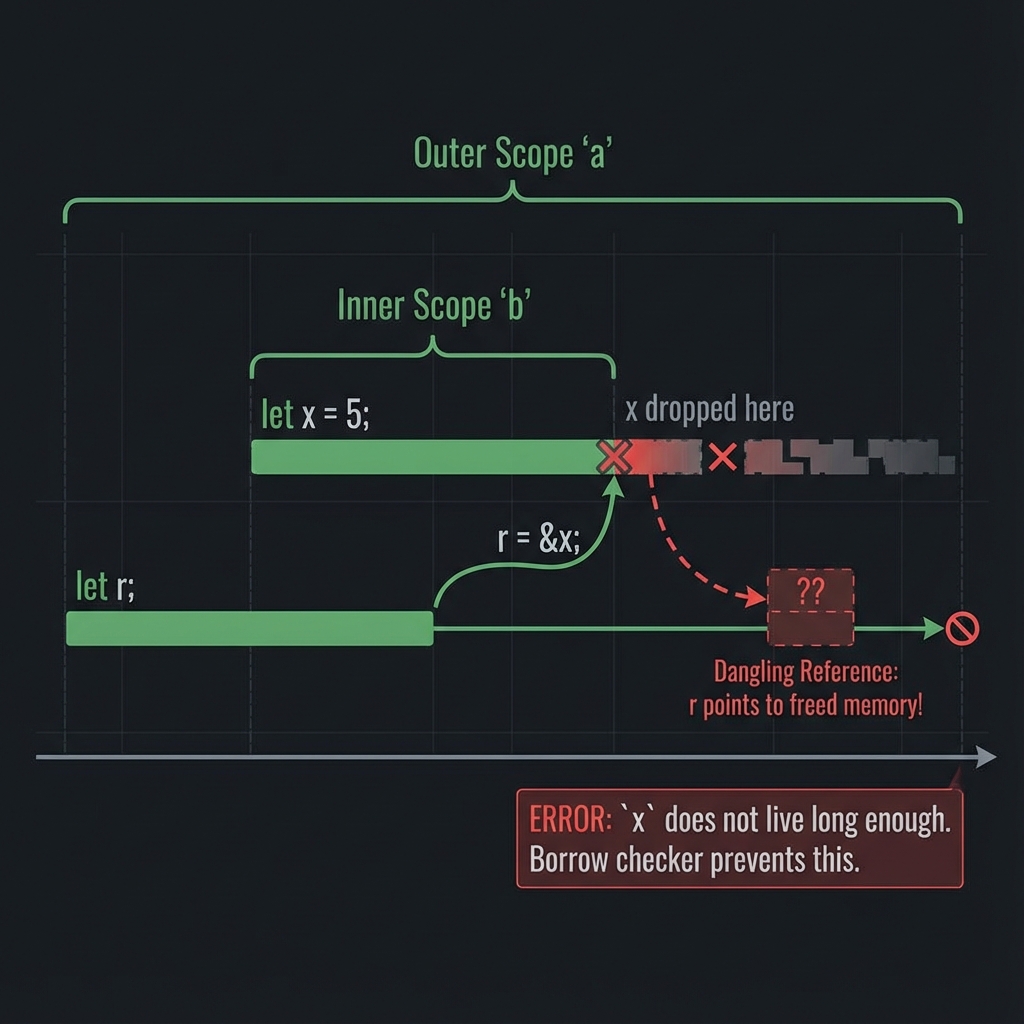
🧠 Mental Model
🔧 Common Patterns
1. Input → Output (ใช้ lifetime เดียวกัน)
   fn get_first<'a>(list: &'a [i32]) -> &'a i32

2. Struct เก็บ reference
   struct Parser<'a> { input: &'a str }

3. Multiple lifetimes (แยกคนละช่วง)
   fn foo<'a, 'b>(x: &'a str, y: &'b str) -> &'a str

4. 'static (อยู่ตลอดโปรแกรม)
   const MSG: &'static str = "Hello";
ปัญหา: Dangling Reference
fn main() {
    let r;                // declare r
    {
        let x = 5;
        r = &x;           // ❌ x จะหายเมื่อออกจาก scope
    }
    // println!("{}", r); // Error! r points to invalid memory
}
+---------------------------------------------------------+
| Dangling Reference |
+---------------------------------------------------------+
| |
| let r; ---------+ |
| { | |
| let x = 5; <--+ r points to x |
| r = &x; |
| } <-- x dropped here! |
| |
| r -> invalid memory |
| |
+---------------------------------------------------------+
Rust compiler จะ reject โค้ดนี้เพราะ x ไม่อยู่แล้วเมื่อใช้ r
Lifetime Syntax
&i32        // reference
&'a i32     // reference with explicit lifetime 'a
&'a mut i32 // mutable reference with lifetime 'a
'a (อ่านว่า “tick a”) คือ lifetime parameter บอกว่า reference มีอายุเท่าไหร่
Lifetime ใน Functions
ปัญหา: Compiler ไม่รู้ว่า return อะไร
#![allow(unused)]
fn main() {
// ❌ Error: missing lifetime specifier
fn longest(x: &str, y: &str) -> &str {
    if x.len() > y.len() {
        x
    } else {
        y
    }
}
}
Compiler ไม่รู้ว่า return value จะอยู่นานเท่า x หรือ y
ทางแก้: Lifetime Annotations
fn longest<'a>(x: &'a str, y: &'a str) -> &'a str {
    if x.len() > y.len() {
        x
    } else {
        y
    }
}

fn main() {
    let string1 = String::from("long string is long");
    let string2 = String::from("xyz");

    let result = longest(&string1, &string2);
    println!("Longest: {}", result);
}
ความหมาย: Return value จะมีอายุเท่ากับ lifetime ที่สั้นกว่าระหว่าง x และ y
Lifetime กับ Scope
fn main() {
    let string1 = String::from("long string is long");

    {
        let string2 = String::from("xyz");
        let result = longest(&string1, &string2);
        println!("Longest: {}", result); // ✅ OK
    }

    // println!("{}", result); // ❌ result ไม่มีแล้ว
}

fn longest<'a>(x: &'a str, y: &'a str) -> &'a str {
    if x.len() > y.len() { x } else { y }
}
Lifetime Elision Rules
Compiler มีกฎ 3 ข้อที่เดา lifetime ให้อัตโนมัติ:
Rule 1: Input Lifetimes
แต่ละ reference parameter ได้ lifetime ของตัวเอง:
fn foo(x: &i32)                    // -> fn foo<'a>(x: &'a i32)
fn foo(x: &i32, y: &i32)           // -> fn foo<'a, 'b>(x: &'a i32, y: &'b i32)
Rule 2: Single Input → Output
ถ้ามี input lifetime เดียว ใช้กับ output ทั้งหมด:
fn foo(x: &i32) -> &i32 // -> fn foo<'a>(x: &'a i32) -> &'a i32Rule 3: Methods with &self
ถ้ามี &self หรือ &mut self ใช้ lifetime ของ self กับ output:
impl Foo {
    fn bar(&self, x: &str) -> &str // -> fn bar<'a, 'b>(&'a self, x: &'b str) -> &'a str
}
ถ้ากฎทั้งหมดไม่เพียงพอ → Compiler error → ต้องใส่ lifetime เอง
ตัวอย่าง: เมื่อต้องใส่ Lifetime
#![allow(unused)]
fn main() {
// ✅ Elision works - Rule 2
fn first_word(s: &str) -> &str {
    let bytes = s.as_bytes();
    for (i, &item) in bytes.iter().enumerate() {
        if item == b' ' {
            return &s[0..i];
        }
    }
    &s[..]
}

// ❌ Elision fails - must annotate
fn longest<'a>(x: &'a str, y: &'a str) -> &'a str {
    if x.len() > y.len() { x } else { y }
}
}
Lifetime ใน Structs
Struct ที่มี references ต้องมี lifetime annotation:
struct ImportantExcerpt<'a> {
    part: &'a str,
}

fn main() {
    let novel = String::from("Call me Ishmael. Some years ago...");
    let first_sentence = novel.split('.').next().unwrap();

    let excerpt = ImportantExcerpt {
        part: first_sentence,
    };

    println!("{}", excerpt.part);
}
// excerpt ต้องไม่อยู่นานกว่า novel
Methods on Structs with Lifetimes
impl<'a> ImportantExcerpt<'a> {
    fn level(&self) -> i32 {
        3
    }

    // Rule 3 applies: return lifetime = self lifetime
    fn announce_and_return_part(&self, announcement: &str) -> &str {
        println!("Attention: {}", announcement);
        self.part
    }
}
’static Lifetime
'static หมายถึง reference อยู่ได้ตลอดโปรแกรม:
#![allow(unused)]
fn main() {
let s: &'static str = "I have a static lifetime.";
}
String literals ทั้งหมดมี 'static lifetime เพราะเก็บใน binary
ระวัง!
อย่าใช้ 'static เพื่อ “แก้” lifetime errors โดยไม่เข้าใจ:
#![allow(unused)]
fn main() {
// ❌ Bad: ใช้ 'static แบบผิดๆ
fn get_str() -> &'static str {
    let s = String::from("hello");
    &s  // ❌ s จะถูก drop!
}

// ✅ Good: return owned String
fn get_str_good() -> String {
    String::from("hello")
}
}
Multiple Lifetimes
บางครั้งต้องใช้หลาย lifetimes:
#![allow(unused)]
fn main() {
fn longest_with_announcement<'a, 'b>(
    x: &'a str,
    y: &'a str,
    ann: &'b str,
) -> &'a str {
    println!("Announcement: {}", ann);
    if x.len() > y.len() { x } else { y }
}
}
Lifetime Bounds
ใช้กับ generics:
#![allow(unused)]
fn main() {
fn longest_with_trait<'a, T>(x: &'a str, y: &'a str, ann: T) -> &'a str
where
    T: std::fmt::Display,
{
    println!("Announcement: {}", ann);
    if x.len() > y.len() { x } else { y }
}
}
ลองทำดู! 🎯
- เขียน struct ที่มี lifetime annotation
- เขียน function ที่ต้องใส่ lifetime
- ลองตัด lifetime ออกและดู compiler error
สรุป
| แนวคิด | ตัวอย่าง |
|---|---|
| Annotation | &'a str |
| Function | fn foo<'a>(x: &'a str) -> &'a str |
| Struct | struct Foo<'a> { x: &'a str } |
| ’static | อายุตลอดโปรแกรม |
| Elision | Compiler เดาให้ |
กฎ Elision
- แต่ละ input ได้ lifetime ตัวเอง
- input เดียว → ใช้กับ output
&self→ output ใช้ lifetime ของ self
👉 ต่อไป: บทที่ 11: Modules & Packages